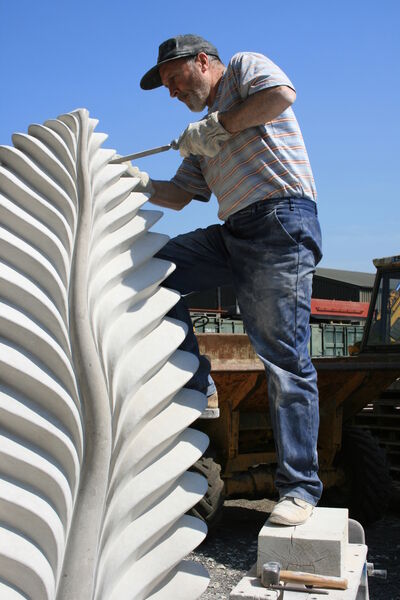
After 30 years in business, sculpture was a complete change of direction. I attended sculpture classes at the Art Academy in London during 2003 and 2004, mainly working with clay and life models. While I was there I was also introduced to stone carving. I attended a number of other stone carving classes, which included working in the Tout quarry on Portland Island and working with Zimbabwean sculptors. In 2004 I was fortunate to work part time for Emily Young, preparing pieces for her St Pancras Crypt exhibition.
I have completed a number of commissions for private collections and a public commission for St Peter’s Hospital near Chertsey – the picture shows me carving this piece in 2010.
In 2019 I started pottery classes with Stephanie Bolter (Old Windsor - Hands-On Art).
__________________________________________
My early work was mainly figurative. These stone carvings were heavily influenced by the wonderful work of Emily Young.
A stone carving course in 2003 on Portland Island, at the heart of the Jurassic Coast in Dorset, led to my fascination in the deep time history of our planet and the evolution of life. From there I started to explore abstract shapes that are influenced by the wide ranging patterns of nature. This included the work of Alan Turing in 1952 on morphogenesis and the patterns generated by reaction-diffusion systems.
I usually select and procure the stone directly from a number of quarries, my favourite being the St Aldhelm quarry in Dorset, not far from the beginning of the Jurassic Coast. This is where I get the stone that I have used most - Purbeck 'marble' (see note below). A lot of my work is carved from offcuts, making use of stone that would otherwise be scrapped.
The stone that I start with gives me the boundaries, or constraints, that can fuel the creative process, particularly if it is not a uniform block of stone. My most satisfying work comes when the ideas and direction gradually take shape as I work, responding to the properties of the material. One advantage of working with stone is that you are able to go back to previous work and change it, from small modifications to completely redesigning a piece.
I have recently been working with recycled building materials (such as roof tiles) and found objects, which can be seen on the page titled 'Abstract Nature 2D'. The Indian Limestone pieces are actually surplus paving stones. From 2018 I have been working with large recycled roof slates from Wormwood Scrubs, and these can be seen on the page titled 'Slates'. The prints (in 'Paintings and Prints') are taken from stone carvings.
_________________________________________________________________
Purbeck ‘marble’ - When the Romans discovered this stone in Dorset (c. AD 200), they called it 'marble' because of the high level of shine when polished. It was used for the decoration of cathedrals and the like for many years, but is now in short supply. It is a limestone full of shells, formed in a warm fresh water lagoon some 135 million years ago (the Cretaceous Period), mainly from millions of fresh water snails (oviparous shells) - hence the wonderful colours.